
Intriguing concepts in gambling recovery: The ‘free money’ that is costing you an emotional & financial fortune
The money you didnt’t have, so you can risk it without guilt
Gambling recovery is full of dichotomies, ironies and contradictions.
Most addicted gamblers have been trying to get richer- or at least get even- by gambling, only to find themselves in more debt than ever.
On the reverse, many gamblers who have fretted for years about how ‘broke’ they would feel when they give up the chance of winning - realise quickly that just hanging on to whatever money they have actually makes them feel quite well off, and in control. It means that whatever you put into your account is there for you when you need it.
A recurring theme among gamblers that often contributes to the drive to chase is the concept of ‘free money’.
Most of you who read this blog are likely to be gamblers, but some might be family members, partners, friends or people who, for whatever reason, find it interesting to read a blog about how to recover from gambling addiction. So for those of you who are not gamblers yourselves, the idea of ‘free money’ may not make much sense. Particularly not as you are watching a loved one wreck themselves financially through the same gambling that they themselves appear to believe is going to make them rich or at least get even.
Free money - the seduction of ‘nothing to lose’
Free money is not a concept taken from the Oxford dictionary, but amongst the gamblers I have worked with over the years, it does appear to have a strong consensus in meaning.
Free money refers to the idea that the money was unexpected or surplus (such as from a win) and since it was not expected or accounted for in any way, why not just risk it!
It is associated with a guilt-free, generous and giving feeling. The idea of the money being ‘free’ is about as logical as when I have, on occasions, brought back an item of clothing to the store, get the money in return and suddenly feel as though I have ‘saved’ some money that I can now just as well spend on something else in the shop. On some occasions, I have even taken it one step further and used the amount that felt saved towards something that set you back even more than the first item.
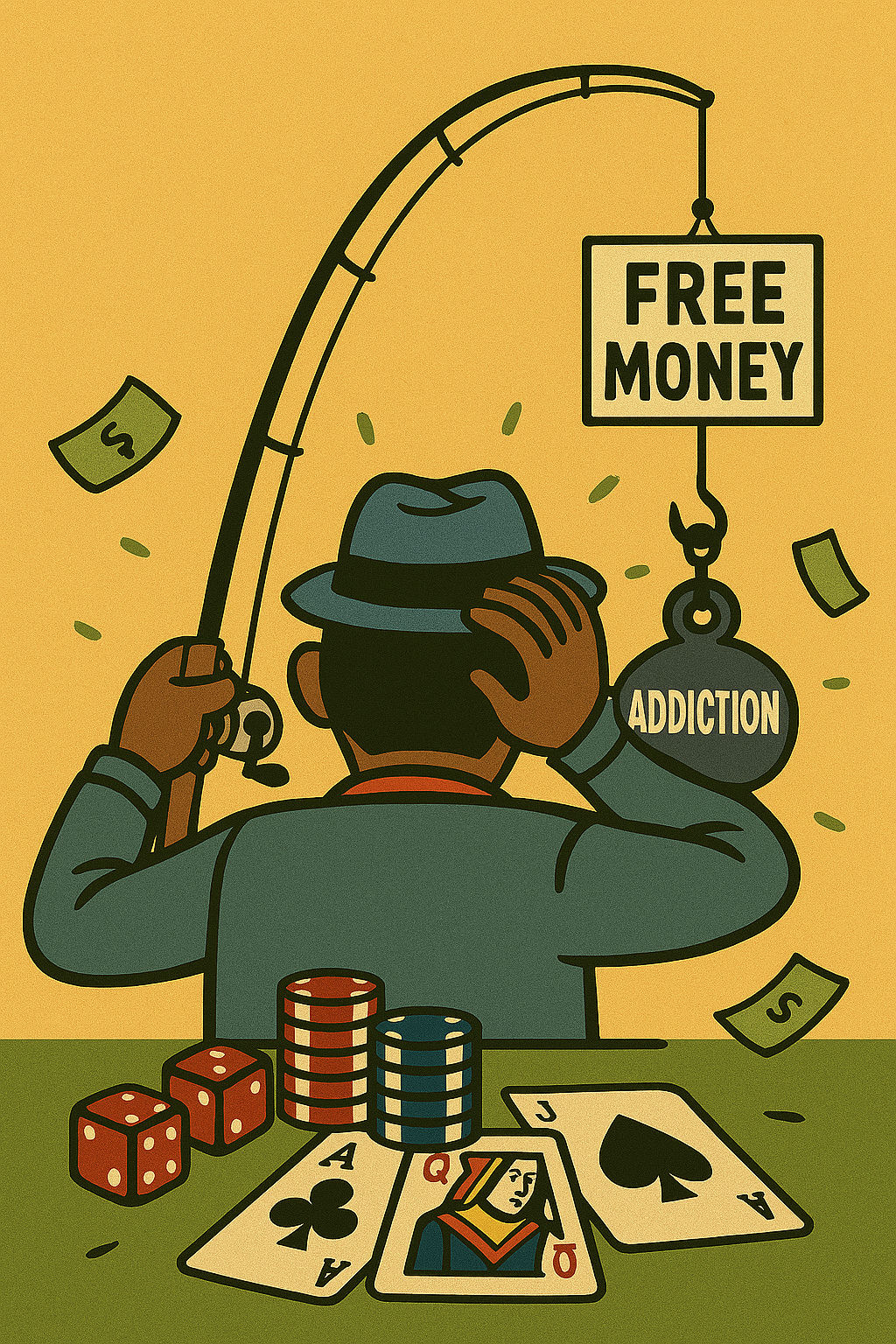
Many gamblers I work with are not only attached to the free money as and when it happens through a win. It can also be felt during times of work bonuses, repayments from people who owe them, or an unexpected £20 note that is found lying around.
The freedom of it all is felt when it is money that you believe you would have been without and now suddenly have to hand.
****Perhaps more concerningly, the concept is also highly prevalent on a variety of gaming and gambling platforms where it will sneak upon you under the guise of anything from treasure chests, bonus rewards and free spins!*****
When getting free money the thinking goes; ‘Nobody (also including myself) will notice if this money goes down the drain - but if I win it would be great though…’
And with this warped logic, ridiculous risks are taken. The type of risk that will almost guarantee a loss. The loss in turn nullifies any money that was coming for free, plus a little bit more. Just like the scenario above with me returning shop items.
The reason I make a parallel to a different behaviour than gambling (and one that is not a true addiction for me) is to illustrate that these forms of illusory thinking are not exclusive to problem gamblers or to the context of gambling.
They are fairly commonplace. It should be said, however, that gambling hijacks a large number of common thinking fallacies and really goes to work on the brain’s tendency to fall prey to emotional reasoning during particularly high and low states of mind.
So even if the rest of the population may also be subject to similar fallacies, gamblers often are hugely affected, if not dictated, by theirs. The stakes are often higher for gamblers as well, since a return to gambling could become prolonged and extremely costly.
Why Gamblers fall for the trap of free money
Gamblers have a strange relationship with risk and rewards; one that sets them up for illusions and thinking errors of all kinds.
In many gamblers I meet with, there is an underlying desire to take risks. If you were to look at the population as a spectrum and assess them on their willingness to take risks, gamblers are very rarely from the category of people who are averse to taking risks.
A few things tend to define their relationship with risks and rewards:
# Risk feels controllable
Even when it isn’t, many gamblers believe skill, intuition, or “reading the moment” gives them an edge, especially after a win. The idea of the risks being measured against statistical chance and logic quickly goes out the window when you identify as someone who is somehow due a win. A wide range of miscalculations, omissions of losses and selective attention and superstitions further contribute to the gambler’s sense of controlling the outcome.
# Rewards and wins are amplified and their importance inflated.
While the wins are blown out of all proportion, losses are often reframed as moments of bad luck and seen as something highly unlikely to continue happening. The mental ‘filter’ very efficiently appears to make gambler’s minds dissociate from how much time, stress and financial loss went into simply trying to win back what has been lost. Seen financially there is no reward that actually materialises. But there is the intermittent feeling of having one, and this shields the reality very powerfully.
# Near misses & losses
Near misses (the experience of almost winning) have been researched extensively and have been shown to act as a driving force of continued motivation to gamble. Logically, anything other than winning is losing! No matter how close to winning you get. But the brain comes to interpret the near miss as a cue to keep going since you feel like you are so nearly there. As bad as the losses may feel, it is not unusual to see them get dismissed as ‘the cost of finally having a shot at that big win’ rather than for what they are. Losses that are usually guaranteed and often irreversible.
# The chase matters more than the outcome.
The anticipation, the tension, the almost — dopamine fires hardest before the result, not after. That’s why stopping after a win can feel harder than stopping after a loss. The process of gambling is addictive in its own right and even if the mind tries to tell itself that it is ‘just to win some more’ this is clearly not the case unless you are someone who has been known to stop when you are still on the plus-side financially.
# Probability becomes personal
Random events start to feel like they have memory (“I’m due,” “it can’t happen again”), even though statistically they have no personal relationship with the gambler whatsoever. Yes, there will be the occasional time when the gambler has applied some kind of skill when gambling. One that once upon a time could have been the edge that could have made that gambler win the millions and retire well. But as I say to all my gamblers who try to claim they have the winning edge; if that mattered still they would not be where they are with the gambling. The only thing that counts is whether you have control or not. Without control, even a win will keep you gambling until you are financially wrecked.
The collapse of rational thought
Addicted gamblers are often emotional about their gambling, but they are far from stupid and ignorant. Some of my gambling clients are far more clever than the average person. Unfortunately, a person’s intellectual ability has little to do with outsmarting an addiction. This is because the failing logic and reasoning have nothing to do with intellect.
It is the direct result of the strong emotion involved in the gambling itself, and if anything, an underlying flair for risk-taking and thrill that can create a perfect storm for losing big. An overall more cautious person might have chosen to stop after facing the first loss, while someone who does not mind a bit of thrill and tension will be less likely to do so.
Most gamblers understand the odds perfectly in theory. Yet when the chase is on, that piece of knowledge no longer has relevance. The conviction that a win will come in is far more dominating. When the brain weighs things up, even a little possibility of a reward can feel more real than a guaranteed loss.
As the gambling addiction gets a foothold, the reasoning gets increasingly warped due to the emotional rollercoaster the gambling creates.
Normal logic could have suggested that an increasing loss should also increase the felt risk of losing more. For addicted gamblers, the desperation to win back what has been lost and any intermittent excitement that occurs when a win happens means that this logic is flipped on its head.
So instead of stopping timely, the drive ramps up to increase risk in the hope that the rewards will come in at last. Only, the chances of that happening are unchanged. There was never a genuinely high likelihood of winning from gambling. But gambling psychology ensures that the mind believes it will win- even when the opposite is proven time and again.
How free money fuels the gambling addiction
The free money feels disconnected from effort- You feel like you can just as well toss it all in
As many of you who are addicted to gambling will know already, the respect for the value of money is not where it needs to be. Still, you are more likely to respect the money you have seen, held in your hand and have felt the burden of work to achieve. Interestingly, I also see a lot of gamblers who start relating to money as ‘free’ the minute it is a little more than they expected. Even in situations when they have actually worked really hard to earn it. So the factor of it being free is probably not the main thing. The key is that it is in surplus to expectation and experienced as a bonus. This ‘bonus-feeling’, in turn, makes it tempting to abandon previous limits and stoppers.
The mind of an addicted gambler gets both sneaky and greedy. This is not said as a reflection of who you are as a person, but nevertheless, such a prominent feature of how the addiction makes itself heard. You therefore need to have some awareness of what your mind will do with the idea of any money being free.
Using winnings to gamble again creates a cycle where each ‘free’ dollar/pound disappears quickly.
Even experienced gamblers can fall prey to this, because the illusion of free money is reinforced by the brain’s thrill-seeking tendencies.
How to recognise the true cost
Financial cost: How much of this money will I realistically lose if I gamble?
Emotional cost: How will gambling with this money affect my stress, guilt, or anxiety? Particularly beyond today…
Opportunity cost: Could this money be better spent on essentials, debt, or something meaningful?
Past patterns: Have I gambled in similar situations before? What were the consequences? Touching base and trying to connect not just with the thought of past times but also with the feeling of the aftermath can be a powerful deterrent.
So next time you are faced with the lure of some free money, whether from a win, from a casino, from an online treasure chest or money that you found in a forgotten account, read through this article, take a shower
Key insight: If money encourages you to gamble, it is not going to be free.
Practical Steps to Break the Free-Money Illusion
Count your real losses
Subtract any previous losses from unexpected funds before thinking of it as surplus.Redirect the money
Use ‘found’ money for harmless, positive purposes: groceries, bills, a treat that doesn’t trigger gambling.Pause and reflect
When tempted, take a moment to consider the emotional and financial risks. Write them down if needed.Strengthen perspective
Remind yourself of past consequences. Reinforce the reality that gambling is rarely profitable in the long term. Certainly not for anybody who has a trackrecord of losing control over the limits.Replace the thrill
Find safer ways to enjoy anticipation and excitement: sports, puzzles, hobbies, or social activities.
The Bottom Line
“Free money” is a trick your brain plays to justify gambling. It feels harmless, even rewarding—but it comes at a cost that is almost always greater than imagined. Recognising it for what it is, and redirecting it responsibly will pay off more than any gambling ever will.
Wishing you all the best on your recovery journey
Annika X